
The dream of humans for human mission to Mars is not far away now but the biggest challenge in this remains the long travel time.

Source: Youtube – Video Credit: NASA
Nuclear Propulsion: Why Current Rocket Technology Is Too Slow
The dream of humans for a mission to Mars is not much longer now but the biggest challenge in this is the long travel time in space exploration which has brought incredible advancement for humanity. Traditional chemical rockets were six to nine months take to in reaching the red planet by exposing astronauts to dangerous cosmic radiation and psychological strain which extends space travel however nuclear propulsion technology could change this game which would potentially cut travel time in half.
In this article, we will explore how nuclear propulsion works, why it is superior to chemical rockets, and how it could make the Mars mission faster, safer, and more feasible. In comparison to the before.
Chemical rockets such as those used by NASA Artemis Program or SpaceX Starship that rely on combustion to generate thrust are highly effective for launching payloads from the surface of the Earth. They face significant challenges in long-distance space travel.
- Low efficiency: chemical propulsion that has low specific impulse (fuel efficiency), this means more fuel is required for it.
- Long travel times: a typical Mars mission takes six to nine months which increases the risk of health issues for astronauts.
- Radiation exposure: the longer astronauts stay in space, the higher the risk from radiation and microgravity effects.
To achieve faster and safer travel, space agencies and private companies that now looking at nuclear propulsion as a revolutionary alternative.
Why do chemical rockets take so long to reach Mars?
Understanding Nuclear Thermal Propulsion (NTP):
Nuclear thermal propulsion (NTP) is one of the most promising technologies for cutting down Mars travel time. It works by:
1. Using a nuclear reactor to heat liquid hydrogen fuel.
2. The superheated hydrogen is expelled through the nozzle to create thrust.
3. NPT which allows twice as efficient chemical propulsion, higher speeds with less fuel.
As we know, NASA and DARPA are currently developing the DRACO (Demonstration Rocket for Agile Cislunar Operations) project which aims to test a nuclear thermal rocket by 2027.
How does nuclear thermal propulsion works?
Another approach is Nuclear electric propulsion (NEP) which:
- Such as a nuclear reactor used to generate electricity.
- Uses ion thrusters which create steady low thrust acceleration.
- Offers extreme efficiency but accelerates more slowly than NTP.
Both methods offer huge advantages but NTP is currently the leading candidate for Mars mission due to its high thrust-to-weight ratio.
Related:
The Science Behind NASA’s Latest Mars Rover
SpaceX 2025 In-Orbit Refueling Test: Paving the Way for Mars Missions
What is the difference between NTP and NEP?
Cut the Travel Time in Half & Challenges and Risks
With nuclear thermal rockets, we can reduce the travel time to Mars to just 3 to 4 months instead of 6 to 9 months. Here is why:
- Higher efficiency: NTP which provides twice specific impulses of chemical rockets.
- Faster acceleration: nuclear rockets can achieve higher speeds in shorter timeframes.
- Flexible mission windows: faster travel which allows frequent launch opportunities or reducing delays.
How much time can nuclear propulsion save on a Mars trip?
Reducing Astronauts Risks: Shortening the journey means astronauts will spend
- Less time exposed to harmful cosmic radiation.
- Less time in microgravity, which can cause muscle and bone loss.
- Less psychological stress, improving crew well being.
Why is faster Mars travel important for astronauts?
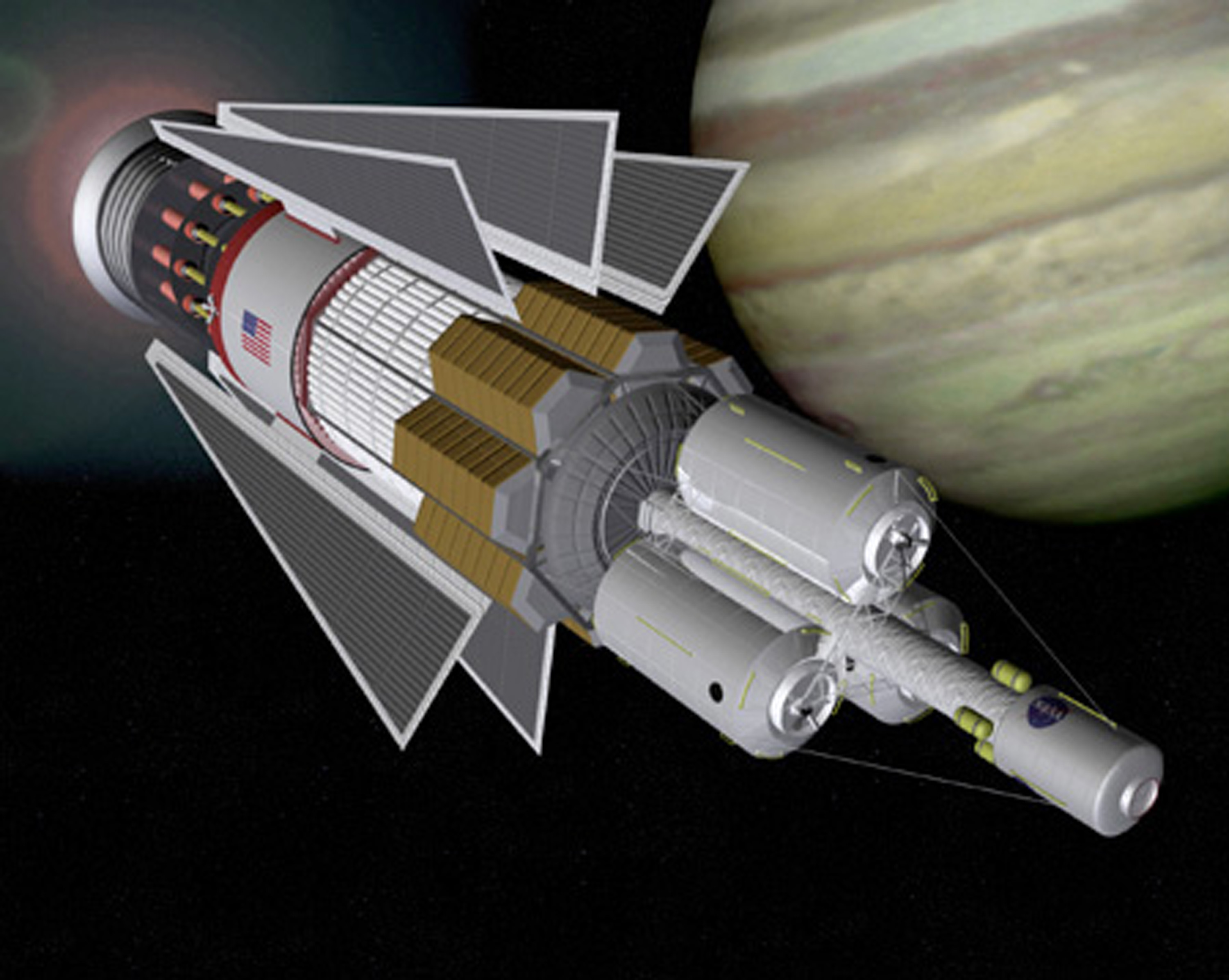
- Date Created:1999-01-01
- Credit: NASA Images
While nuclear propulsion has major benefits, it also has challenges:
- Nuclear safety concerns: Space reactors must be designed with stand-by accidents without radiation leaks.
- Development costs: Research and testing for nuclear propulsion are very expensive and time-consuming.
- Political and public concerns: Nuclear technology can raise geopolitical and environmental concerns in space.
What are the biggest challenges of nuclear propulsion?
Nuclear Propulsion vs. SpaceX's Starship: A Competitive Edge?
Despite these challenges, nuclear propulsion is gaining strong support from NASA, DARPA, and private companies like Blue Origin and Lockheed Martin are actively investing in nuclear rocket research, if it is successful then we could see:
- A nuclear-powered Mars mission by the 2030s.
- Faster interplanetary travel, paving the way for colonization.
- Future missions to Jupiter and beyond using nuclear propulsion.
When will we see the first nuclear-powered Mars mission?
SpaceX Starship is currently designed using chemical propulsion but integrating nuclear propulsion offers game-changing benefits:
- Starships can reach Mars faster with nuclear propulsion and return quickly.
- Combining nuclear or chemical propulsion can oppress fuel efficiency.
- NASA-SpaceX is collaborating on nuclear technology which will accelerate its development.
If SpaceX integrates nuclear propulsion we could witness the fastest Mars mission in history.
Could SpaceX use nuclear propulsion for Starship?
Potential Applications Beyond Mars & The Key to Faster Mars Travel
- Date Created:2023-01-24
- Credit: NASA Images
Nuclear propulsion, which is not just for Mars, future applications include:
- Lunar Missions: Faster transport between Earth and the Moon.
- Asteroid Mining: Efficient travel to asteroid belts.
- Deep Space Exploration: Mission to Jupiter, Saturn, and Beyond.
This technology could transform our entire approach to space exploration.
Can nuclear propulsion be used for other planets?
Nuclear propulsion represents a breakthrough in space travel which offers a faster, safer and more efficient way to reach Mars which cuts the travel time in half It can transform humanity’s journey towards the red planet and beyond it.
If this happens, we can colonize Mars as quickly as possible As you know, we have to wait for about 2 years to launch missions to Mars because after these 2 years, there comes a time when the distance between Earth and Mars becomes very less and then the time to reach Mars gets reduced considerably.
One of ours For this there is one benefit and another one can happen that if we make a nuclear propulsion system then it would happen as said that our warehouse will become useless, whoever takes this step should be a private company or a government agency, whether it is for money or humanity, the benefit will be to humanity only, we believe that if Elon Musk’s company SpaceX does this work as this company has shown us by doing it, no other company could do it like this in a few years, you let’s see what can happen, I think you will get a lot of success from SpaceX and Elon Musk.
As the research is ongoing and successful testing is also being done, the first nuclear-powered Mars mission can happen, in which corner is our group, the future of space exploration which is nuclear powered, and it is a lot closer than we think.

Tabish Virk
Tabish is a passionate space writer and visionary thinker exploring the frontiers of the cosmos through powerful storytelling. With a deep interest in space missions, astronomy, and the future of humanity beyond Earth, he aims to ignite curiosity and bring space closer to everyday readers. His work reflects a lifelong fascination with the stars and a belief that the future belongs to those who dare to look up.
